
St. Guthlac of Crowland - the English Anthony the Great
Updated: Nov 9

The Venerable St. Guthlac of Crowland (c. 673-714) is regarded as one of the most extraordinary hermit-saints of the early English Church and is considered the most popular pre-Norman English saint after St. Cuthbert. Orthodox Christians refer to him as "the English St. Anthony the Great." Crowland Abbey Church, located in the tranquil village of Crowland in Lincolnshire, near the Cambridgeshire border in the Fens—a region where Guthlac led his ascetic life—draws Orthodox and other Christian pilgrims annually. The Fens is a low, flat area encompassing parts of present-day Lincolnshire, Cambridgeshire, and Norfolk, historically known for its predominantly marshy landscape, which was largely reclaimed between the 17th and 19th centuries.
"It is well known that many desert fathers in ancient times, particularly in Egypt, lived in the desert. In contrast, the hermits of the British Isles chose small islands, shores, cliffs, forests, mountains, and hills as their "deserts," since Britain lacks natural deserts. Guthlac was distinctive even among English saints, as he chose to live as a hermit surrounded by treacherous and impassable bogs and swamps. His spiritual endeavors and experiences closely mirrored the lives of the venerable monks of the Egyptian deserts."
Early Life

The earliest and most reliable account of the life of Guthlac was authored by the monk Felix approximately 20 years after the saint's death. By the grace of God, this Latin account has survived to the present day. In addition to this work, two other vernacular versions were later composed in Old English, one in verse and the other in prose. Furthermore, the British Library houses a remarkable medieval artifact known as the Guthlac Roll, which presents an illustrated narrative of his life through 18 exquisite roundels (circular designs). St. Guthlac was born into a noble family in the early English kingdom of Mercia, which was connected to the royal house of Mercia. At that time, the pious King Ethelred ruled Mercia; he reigned for about 30 years, was instrumental in founding numerous monasteries, and eventually became a simple monk himself. Following his death, he was venerated as a saint at Bardney in Lincolnshire. Guthlac's father's name was Pendwald, and his mother's was Tett. In addition to Guthlac, his parents had at least one other child, a daughter named Pega. Pega was a virgin and anchoress, and after her death, she was also honored as a saint. We will discuss her further later.
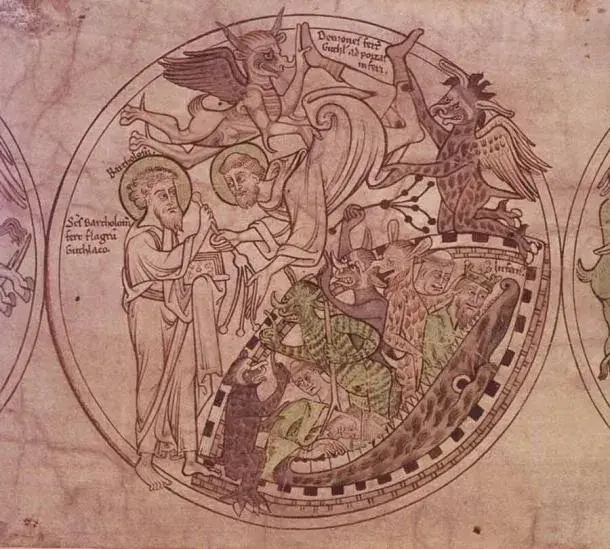
"The birth of the great hermit Guthlac was accompanied by marvelous miracles - a red hand from heaven appeared to gift a golden rood over the house where St. Guthlac was born. The parents and all the relatives felt that this child would surely become a man great in the eyes of God and in the eyes of men. Guthlac was an obedient boy; he avoided all the usual childish games and pranks or idle talks. He grew into a very clever adolescent, his face always shone with a particular spiritual joy; he was innocent in all his activities."
However, with time his temper changed very radically: Guthlac was a descendent of kings, tracing his ancestry back to Icel, son of Eomer. Icel had led his people, the Angles, West across the sea to carve out a new kingdom. He longed to follow in his ancestors' footsteps and joined the military. Guthlac turned out to be good at war. Soon he was having enough success that his warband filled up with men who were not his relatives. Any noble might bring his kin to the battlefield, but a great leader attracted those who fought for gold or glory. Now in his early twenties, Guthlac was getting both.
We don’t know the details of Guthlac’s war. The Britons of this time were not passive victims, and led out by men like St. Tewdrig they won battles as well as lost them. We know that they captured Guthlac at least once. Somehow Guthlac made his escape. We also know that he wreaked bloody vengeance on those who had captured him, raiding and burning until his enemies begged for peace.
Monastic Life
"He eventually formed his own gang and raided villages and committed horrendous crimes until one day he decided he needed to repent, turn to the Lord and he left his brigandage. He gave back all his loot to the people and called upon his gang members to do the same. After that, following the Lord’s revelation, St. Guthlac came to the double Monastery of Repton in the present-day county Derbyshire which was in Mercia. He wished to start serving Christ as a monk there. St Guthlac lived at Repton in extreme abstinence."
First the brethren were not very friendly with him because he totally refused any alcoholic drinks but then, seeing his genuine ascetic life, love and kindness, they became his close spiritual friends. In Repton, st. Guthlac soon learned the whole Psalter by heart. He studied the Gospel and teachings of the Holy Fathers very thoroughly and zealously practised everything he found in their instructions. Once he read the Lives of the Egyptian desert fathers he began to have a strong and fervent desire to imitate their way of life in order to be closer to Christ Whom he loved most of all. So the saint resolved to live alone in the wilderness.
Hermit's Life

He found some local people in the Fens and one of them, named Tatwin, showed him a small, uninhabited isle right in the middle of this extreme swampy region. Also Tatwin told Guthlac that nobody had been able to live there because of hordes of evil spirits, demons, who dwelt there. Guthlac at once felt that it was his calling to live on that very spot and to struggle with these demons there in the Name of the Savior. At the age of about 26 st. Guthlac settled on this tiny and dangerous isle, called Crowland, and he stayed there as a true hero, the warrior of Christ, for the remaining 15 years of his life.
By Divine providence, st. Guthlac arrived on Crowland on the feast-day of the Holy Apostle Bartholomew (August 25) and this saint from that time became his main patron. There was an old tumulus in Crowland which had partly been dug out by treasure hunters and there was a large basin with clean water beside it. There st. Guthlac built a little cell and a chapel for himself. The saint wore only animal skins and ate no more than once a day. He had only barley bread as his food and only water for drink. Most of the day he prayed and gave himself up to Divine contemplation.
Temptations & Trials

"While on the island, St. Guthlac was vexed and tormented by demons. One time, these vile creatures opened up a portal to Hades and attempted to drag him into it, after beating the saint with iron rods and chucking him into a thorn-ridden bramble bush to make him bleed. St. Guthlac called on Holy Apostle Bartholomew, who gave him a scourge (a three-pronged whip) to fight the demons off. "
The saint usually won his battles against the temptations and demons by the sign of the cross, by reading the Psalter, especially Psalm 90, and by petitions for emergency help to his patron-saint, St. Bartholomew. Among his most frequent temptations were despair, the memory of his former sins that “would never be forgiven” and the memory of the outside world - with much courage he struggled with all these thoughts and every time with the help of God he was the winner. Many times angels appeared to him for consolation and in the final years of his life an angel descended to his cell every night and conversed with him till the morning.

"Once two demons appeared to him and spoke with the hermit in a very friendly way, though flattery and meaningless instructions were seen in their words. By these sly speeches they intended to deceive the hermit and to lead him into self-delusion. They said how they honoured his self-denial and hard labours for the sake of Divine service. They also recommended him to fast six days a week and to relax his fasting and rest more on the seventh day. The saint, ignoring them, cried to the Lord imploring Him to protect him: and the demons disappeared like smoke."
One day in the middle of the night demons burst into the saint’s hut and set it on fire (with a phantom fire). The next moment they started beating the ascetic with spear points. St. Guthlac immediately started singing the verses from the Psalter and the demons vanished with their fire.
Spiritual Gifts & Miracles
After years of conflict, peace finally arrived, and the tempters permanently left the location, making it sacred ever since. Guthlac received great wisdom, the spirit of prophecy, clairvoyance, the capacity to heal numerous illnesses, and the ability to drive out demons from possessed individuals as a reward for his unceasing and fearless work for the glory of the Lord. His life narrates how Guthlac was a very close friend to wild animals, including fish, birds, and beasts, and how the natural world served him as its master in exchange. He also saw events that were happening far away from him, saw the thoughts and intentions of many people, and saw the future as if it were the present.
An ascetic called Wilfrid together with the future king Ethelbald of Mercia decided to pay a visit to st. Guthlac one day. Arriving at Crowland, they left Wilfrid’s gloves in the boat. After conversations on spirituality st. Guthlac asked them whether they had left anything in the boat, knowing already that one of the ravens had taken the gloves. The guests confirmed this and when they left his cell they saw the raven sitting on its roof with one glove in its beak. St. Guthlac commanded it to obey and the bird let it fall on the ground. Meanwhile three other guests arrived by boat and passed Wilfrid his other glove saying that a raven had dropped it as they were sailing nearby.
With time the fame of Guthlac, the extraordinary great ascetic and man full of the grace of God, spread all over Mercia and finally all England. Though the saint never left Crowland several other ascetics and future saints became his disciples. More and more people flocked to his hermitage: the young and old, the sick and suffering, poor and rich, peasants and nobles: all flocked to Guthlac and received bodily and spiritual healing, good advice, and consolation. Sinners received heartfelt instructions and changed their way of life. The names of the closest disciples of Guthlac are Cissa, Bettelin (both of them were locally venerated as saints), Egbert and Tatwine.
"The story of St. Bettelin (also known as Beccel) is truly remarkable. As a priest, Bettelin decided to visit Guthlac, whom he had heard much about, to ask for permission to stay with him forever on the island as his servant. However, due to his spiritual weakness, the priest was ensnared by a malevolent spirit and resolved to kill Guthlac, believing that by doing so, he could remain in Guthlac's dwelling and be venerated by the faithful instead. Yet, the wicked thoughts of men were laid bare before Guthlac, and when Bettelin approached him, the saint spoke first: “Why have you, dear brother, allowed the evil spirit to conquer your mind? You have been deceived by him. Turn away from these cunning designs and treacherous tricks of our common enemy.” Bettelin repented, and in tears, he promised to always heed the saint’s words. In turn, the saint forgave him and kindly vowed to guide him."
Another time the same monk Wilfrid came to st. Guthlac to exchange spiritual words with him. As they were sitting in his cell, two swallows flew into it through the window and joyfully sang their ringing song to the ascetics. They first landed on the shoulders of st. Guthlac, next on his breast, hands and knees, doing it very affectionately. Wilfrid was amazed and asked why they were so fearless with him. st. Guthlac replied that wild creatures always make friends with those people who live exactly according to the will of God, but they flee those who seek to be close to the external world.
There lived a very pious youth who honored and helped his parents. But a wretched spirit got into him and the lad went mad. The wicked spirit seized his mind and will so the young man scratched and bit himself and tried to attack anyone who approached him. His family members tied him up and took him to a certain monastery where elders prayed for him for very long, but to no avail. Frustrated, the people did not know what to do. At that time someone told them that among the marshes, in Crowland, there lived a holy monk named Guthlac whose fame as wonder-worker spread far and wide. With great difficulty, but with hope for Divine protection, they took the young man to Guthlac. The man of God prayed in his chapel above the possessed youth for whole three days and in the end, sprinkling him with holy water, delivered him from the evil spirit forever.
Another man named Ecga also suffered a great deal from the unclean spirit. His state was so bad that he did not even understand what was happening to him. His kinsmen took him to Guthlac. The latter met them with Divine love, girded the sick man with his belt and the demon left him in the same minute. One day an abbot who was Guthlac’s spiritual friend decided to visit him. Two monks from his monastery joined the abbot but on the way they asked him to permit them go and do one very important and urgent thing. When the abbot was conversing with Guthlac, the latter unexpectedly revealed him that his monks were not engaged in a pressing matter, but were visiting a widow with whom they drank strong alcoholic drinks.
On his return to the monastery the abbot asked the two monks what they had done and then put them to shame when they declined to confess. The monks prostrated themselves in tears and sincerely asked forgiveness. Another day two monks went to see Guthlac and before arriving decided to hide two flasks with beer that they carried under the grass. The saint greeted them with fatherly love, gave them instructions on salvation and then genially asked them: “Why did you hide the flasks with beer under the grass and did not bring them with you?” Ashamed, the monks bowed to him and asked for his blessing.
A man named Offa once decided to come and see Guthlac. While he was making his way through a thicket in the darkness a large thorn penetrated his foot. The foot began to swell badly and the man with great difficulty limped to the hermit’s island. Guthlac saw him and immediately gave him clothes to put on. As soon as Offa had done this, the thorn came out of his foot and flew away a great distance. Receiving spiritual consolation, Offa departed joyful and healthy. Once a bishop named Hedda who venerated Guthlac very much decided to visit him and offer him ordination to the priesthood. One of Hedda’s companions, an intelligent young man, during the journey boasted that he would come and (using his knowledge and experience, received among holy men in Ireland) find out whether Guthlac was a true servant of God or not, whether he worked miracles through the powers of Holy Spirit or the power of Satan.
When Hedda arrived, they started talking and were soon impregnated with the vivifying power of the Gospel. Guthlac was so eloquent and wise and the spiritual light of Christ shone in him so brightly that it seemed to everybody that not a man, but an angel was speaking in front of them. Hedda implored Guthlac to accept his offer to become a priest and Guthlac agreed, saying that it was the will of God that he should serve Him in the altar. During the common meal Guthlac suddenly addressed the above-mentioned young man and said: “What will you say, brother, regarding the priest of whom you pledged to find out whether he was good or bad?” The young man prostrated himself in front of the saint weeping and Guthlac embraced him as a sign of forgiveness. Thus, Guthlac was ordained priest.
Shortly before his repose Abbess Edburga of Repton (whose relics were later translated to Southwell Minster in Nottinghamshire) who loved and venerated Guthlac sent him a shroud and a leaden coffin that she had prepared herself. She implored him to accept these gifts for Christ and she also asked him, knowing his prophetic power, to reveal who would be the following abbot of Crowland after him. Guthlac with humility accepted her gifts and predicted that the next abbot would be a man who then was still among the pagans but who was destined to come shortly and take baptism (he meant St. Cissa)—and this prophecy was fulfilled in due time.
Not long before Guthlac’s repose the future king Ethelbald visited him again. At that time he was persecuted by the reigning king and abandoned by everybody. Guthlac encouraged him, saying that God would help him to succeed to the throne, but for this he should be patient and indulgent to others, to forgive all his enemies. “Do not fear, but be steadfast, for the Lord is your Helper”. This phrase he used to repeat to others as well, encouraging them to put their hope in God alone in difficult situations. Notably, soon after his death Guthlac appeared to Ethelbald in a vision and reassured him again and repeated his promise. And soon Ethelbald became king and in gratitude for Guthlac’s miraculous help he ordered the building of a monastery on the site of the heroic spiritual battles of Guthlac.
His Repose
"Eight days before his repose, Guthlac fell seriously ill and began preparing for his death. He became ill during Holy Week and passed away on Bright Wednesday in 714. His faithful servant, Bettelin, remained by his side throughout his sickness. Despite his grave illness, Guthlac offered thanks to God on Easter Sunday and served the Liturgy, after which he delivered an inspiring sermon. The day before his repose, he gave his final instructions to Bettelin, instructing him to go to his sister’s hermitage and ask her to arrange his funeral upon his passing. Just before his death, Guthlac received communion for the last time and took his final breath. At that moment, his cell was filled with the sweetest aroma, everything around him was illuminated by an unearthly light that made the sun appear dim, and the air resonated with the sound of angelic singing.
On the same day, Bettelin arrived at the hermitage of Pega, Guthlac’s sister, who had spent many years as an anchoress in a location now known as Peakirk in present-day Cambridgeshire, near the city of Peterborough. Pega and Bettelin then sailed down the Welland River to Guthlac’s hermitage. It is said that along the way, Pega healed a blind man in what is now the town of Wisbech, indicating that the sister of such a revered saint was also a miracle worker. Upon their arrival in Crowland, the companions found the entire island and the saint’s dwelling enveloped in a light so radiant it was almost unimaginable, accompanied by a fragrance reminiscent of ambrosia and honey."
Many miracles occurred in the first year near Guthlac’s grave. A year after his death had passed, Pega decided to translate her brother’s body into a new coffin. The maiden of Christ invited many clergy and together they opened the tomb. They were so surprised that for some while they could not say a word: the body of the saint was absolutely intact, by his look and flexibility of his limbs he resembled a sleeping man, rather than a dead man and all the garments on him were absolutely unchanged as if he had been dressed in them on the same day. Everybody thanked God for His miracles and translated the relics into a new coffin which was installed in a place of honor in the chapel (later in the abbey church).
Veneration

Veneration for St. Guthlac flourished throughout the Middle Ages. The Abbey of the Virgin Mary, St. Bartholomew and St. Guthlac grew into a large and prosperous monastery which every year received thousands of pilgrims who venerated the relics of St. Guthlac and other saints that were kept there, with countless cases of miracles. In the 9th century King Wiglaf of Mercia and Archbishop Ceolnoth of Canterbury (as writes David Farmer) especially venerated Guthlac who cured the latter from ague. In about 870 the pagan Danish invaders attacked Crowland Abbey and looted it, killing the Holy Abbot Theodore (whose head is kept and venerated in the Abbey Church of Crowland to this day) with many monks when they were serving the Liturgy and since then all of them have been venerated as martyrs.
However, in the following century the abbey was restored by the saintly Abbot Thurketyl (of Danish origin: 787-875, feast—July 11) who at the same time was its great benefactor. Soon afterwards both the popular and liturgical veneration of Guthlac spread all over England and petitions were offered up to him in all the dioceses of the English Church. At least nine ancient churches were dedicated to him and later a small Augustinian monastery in honor of Guthlac was founded in the city of Hereford. In 1136 the new translation of St. Guthlac’s relics into a richly embellished shrine took place (by that time, after 1066, Crowland had
become Roman Catholic). The famous “Crowland Chronicle” was written by the monks of Crowland and was of a considerable renown. Notably, it was one of the abbots of Crowland, John Litlington, who

founded Magdalene College in Cambridge in about 1428.
Sabine Baring-Gould (1834-1924: an Anglican priest from Devon and a hagiographer, hymnographer, novelist, researcher of English folklore, folk songs, lives of ancient local saints and medieval legends) wrote that St. Guthlac is considered as the spiritual father of the University of Cambridge. John Clare (1793-1864: an English poet who devoted his poetry mainly to nature) dedicated one of his sonnets to Crowland Abbey. The Abbey was always noted for its bells, and the first “tuned peal” in England was performed precisely in this Abbey.
Unfortunately, in 1539 by order of Henry VIII Crowland Abbey had been dissolved together with many other English monasteries and the relics of Guthlac were most probably destroyed. However, popular veneration for him has never ceased and in recent times he has been again been venerated by Christians of different denominations living in England. The present large Abbey Church of Crowland is a part of the original huge monastery church. The abbey is very attractive both inside and outside and, among other things, contains some medieval sculptures relating the life of Guthlac. Around the abbey there are ancient monastic ruins and the former west façade of the holy monastery.
St Guthlac's feast day April 11
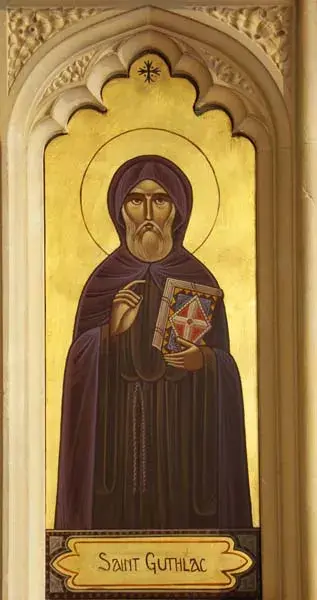
Troparion (Tone V)
Dwelling from thy youth amid trackless and watery wastes, O divinely wise father, with holy zeal thou didst strive to follow the commandments of Christ. Wherefore, the ranks of angels were amazed, beholding thee, a man of flesh and blood, contending valiantly against the passions, O all-wise one, and prevailing over all the hordes of the demons. On earth thou wast a peer of the angels, and in heaven thou art ever an intercessor for mankind. O Saint Guthlac, entreat Christ God, that He save our souls.
Please find his canon here: orthodoxchurchsheffield.com
Prayer to St. Guthlac
"O beloved Father Guthlac, whilst on earth thou didst see the future as if present, distant things as if near, the hearts and minds of men as if they were thine own. We know that in this thou wast enlightened by God, with Whom thou wast ever in the mystical communion of prayer, and with Whom thou abidest eternally. As once Thou didst hear the petitions of thy followers and those who flocked to thee even before they could speak to thee, so now hear our prayers and bring them before the Lord. Thou hast gone over to the life everlasting, unto the other world, yet thou art in truth not far from us, for Heaven is closer to us than our own souls. Show us who are troubled and cast down in sin the same compassion that thou didst once show to those who sought thee out in thy Fenland solitude. Give to us who have fallen into sin, confusion and despair, the same stern, yet loving instruction that thou didst once give to thy chosen flock. In thee we see the living likeness of our Maker, the living spirit of the Gospel, a second Apostle Bartholomew, and the foundation of our Faith. In the pure life that thou didst live we see a model of virtue, a source of instruction and inspiration to those struggling in the ascetic life. Beholding the grace bestowed upon thee, we know that God has not forsaken his people. It is rather we that have fallen from Him, and so must regain the likeness of Divinity as thou hast done. Through thine intercession, O blessed one, grant that we may increase our striving toward our heavenly homeland, setting our affections on things above, toiling in prayer and virtue, waging war against the attacks of our fallen nature. Call on the mercy of God, that we may one day join thee in His Kingdom. For our deepest wish is to live forever with Him, the Father, and the Son, and the Holy Spirit, now and ever and unto the ages of ages. Amen."


Comments