
Holy Hierarch St Ailbe of Emly

Saint Ailbe [also Ailbhe, in Welsh Eilfyw, in Latin Albeus and in English Elvis]
A contemporary, friend and fellow-worker in the vineyard of Saint Patrick, Saint Ailbe is also intimately associated with the patron saints of Wales, Non and her son Dewi. Saint Ailbe is venerated as one of the four great patrons of Ireland.
He is the patron saint of the Archdiocese of Cashel and Emly. Emly is one of the oldest centres of Christianity in Ireland and pre-dates the coming to Ireland of the National Apostle, St. Patrick. Up until the early Middle Ages, Emly was the premier diocese in the south of Ireland.
The life of Ailbe is included in the Vitae Sanctorum Hiberniae (VSH), a Latin collection of medieval Irish saints' lives compiled in the 14th century. There are three major manuscript versions of the VSH: the Dublin, Oxford, and Salamanca. Charles Plummer compiled an edition of the VSH based on the two surviving Dublin manuscripts in 1910.
Early Life
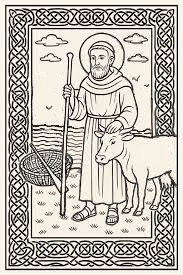
The tradition that goes back to the Vita, or 'Saint's Life', reports that the Saint have been the illegitimate child of a thrall in the household of the Irish prince of Munster. Ailbe's father fled King Cronan before the child's birth and his mother's servants—ordered by the king to put the baby to death—instead placed him on a rock in the wilderness where he was found by a she-wolf who cared for him, protected him and nursed him in his infancy. It was there, many years later, that Ailbe saw an old wolf being pursued by a hunting party and stopped the chase. The bishop and the beast locked eyes, the wolf rushed over to lay her head on Ailbe’s breast, and the tearful saint promised, “I will protect thee, Old Mother.” He kept his foster mother by his side as she spent her last years in the monastery, taking all her meals and sitting on his right side at the table.
Mission
When he was yet a youth he encountered and was baptised by British missionaries who were then serving in Ireland – one of these may have been Saint Palladius. He studied under them, and they, impressed by Ailbe’s quick mind and ease with which he took in knowledge, ordained him a priest. He thereafter made a pilgrimage to Rome, where he was consecrated a bishop. He made his way back to Ireland to find Saint Patrick there evangelising the Irish people.

Saint Ailbe had no objections whatever to the presence of this British bishop, and indeed became St. Patrick’s obedient disciple. St. Patrick placed him in authority over Emly in Munster, though this diocæse was soon relocated to Cashel.
Saint Ailbe was a vigorous and energetic missionary, both preaching the word of truth in a language that ordinary people could understand, and working wonders by the power of his prayers delivered in a spirit of true humility. He lived in accordance with the commandments of God, prayed and fasted and gave openly to all who asked of him. By means of his preaching and teaching under Christ’s and Saint Patrick’s authority, he not only brought multitudes of Irish in the southwest of the island to Christ, but also by his own example of life inspired them to the pursuit of virtue. It is said that he made of ordinary heathen not only Christians but saints.

Ailbe was given the isles of Aran in Galway by Óengus mac Nad Froích, which in turn sound as the foundation of the monastery of Saint Éanna. Ailbe persuaded the same king to give the Aran Islands (which the monarch did not know he possessed until he saw them in a dream) to Saint Enda.
Ailbe also set out a strictly ascetic rule for monks which was followed on Aran for many generations afterward. His own ascetic discipline included constant inward prayer, an early model in the West for the hesychasm and prayers of the heart which would come to be common in the East.
Miracles
A magnanimous Saint, Ailbe prayed for 100 horses as a gift for King Munster. A cloud arose, from which 100 steeds burst forth. Ailbe’s munificence extended to the local peasants who asked him to bless a river that had no fish. St. Ailbe did so; an hour later fish were jumping out of the water. It was said that while on a trip to Rome, he was able to feed the residents of that city for two days.
Repose
Saint Ailbe did not stay his whole life in Emly; like many Celtic missionaries, he was itinerant for much of his career. He ventured into the home country of his spiritual father, and was active in Dyfed. In Wales he is known as Eilfyw Sant, and he was taken by Bishop Rhygyfarch to have been the missionary hierarch who baptised Saint David. If this is true, then he would likely also have been the preacher who was silenced in the presence of Saint Non, and who prophesied the greatness of the unborn baby she carried in her womb. He returned to Ireland to continue his work in Emly, though at the end of his life he took a desire to visit the island of Thule far to the north. The king of Munster, in order to prevent his flight, stationed guards at every port and had them watch for the saint. And so Saint Ailbe reposed in the Lord in Munster as he was going about his duties as bishop. His repose was recorded in the early 6th-century.
Dedications

St Ailbe's Church is a Catholic church in Emly County Tipperary, Ireland, is dedicated to St Ailbe. Built in the 1880s, it replaced an 1809 church.

The sandstone font at the entrance is believed to be medieval, and the nearby graveyard features St Ailbe's Cross, reputedly the saint's tombstone.

There is also in Emly a holy well, dedicated to Saint Ailbe, all of which are still there and are still visited by pilgrims.
There is also a parish dedicated to St Elvis in Dyfed, and of course Saint Eilfyw is associated with the baptism of Dewi Sant and thus with the holy wells that still exist in Dyfed dedicated to Dewi and his mother Saint Non. Saint Ailbe is therefore an important saint both in Wales and in Ireland.

His feast day is 12 September
Troparion
Tone 4
"When Ireland’s Enlightener returned to his native land,
He found thee, O holy Ailbe, preaching the Faith at Emly,
Where at the bidding of an angel thou hadst built a church.
O wise shepherd of souls and glorious ascetic,
O friend of animals, and fellow missionary with the illustrious Padrig,
Pray to Christ our God that we might also become bastions of Orthodoxy
And a shining example to our fellow countrymen,
Drawing them away from ignorance and error
And into the true Faith that all our souls may be saved."
Holy father Ailbe, blessed bishop and tutor of monastics, pray unto Christ our God that our souls may be saved!
Sources: heavyangloorthodox.blogspot.com , en.wikipedia.org


Comments