
St Finnian, the venerable Abbot of Clonard
Updated: 5 days ago
His Life
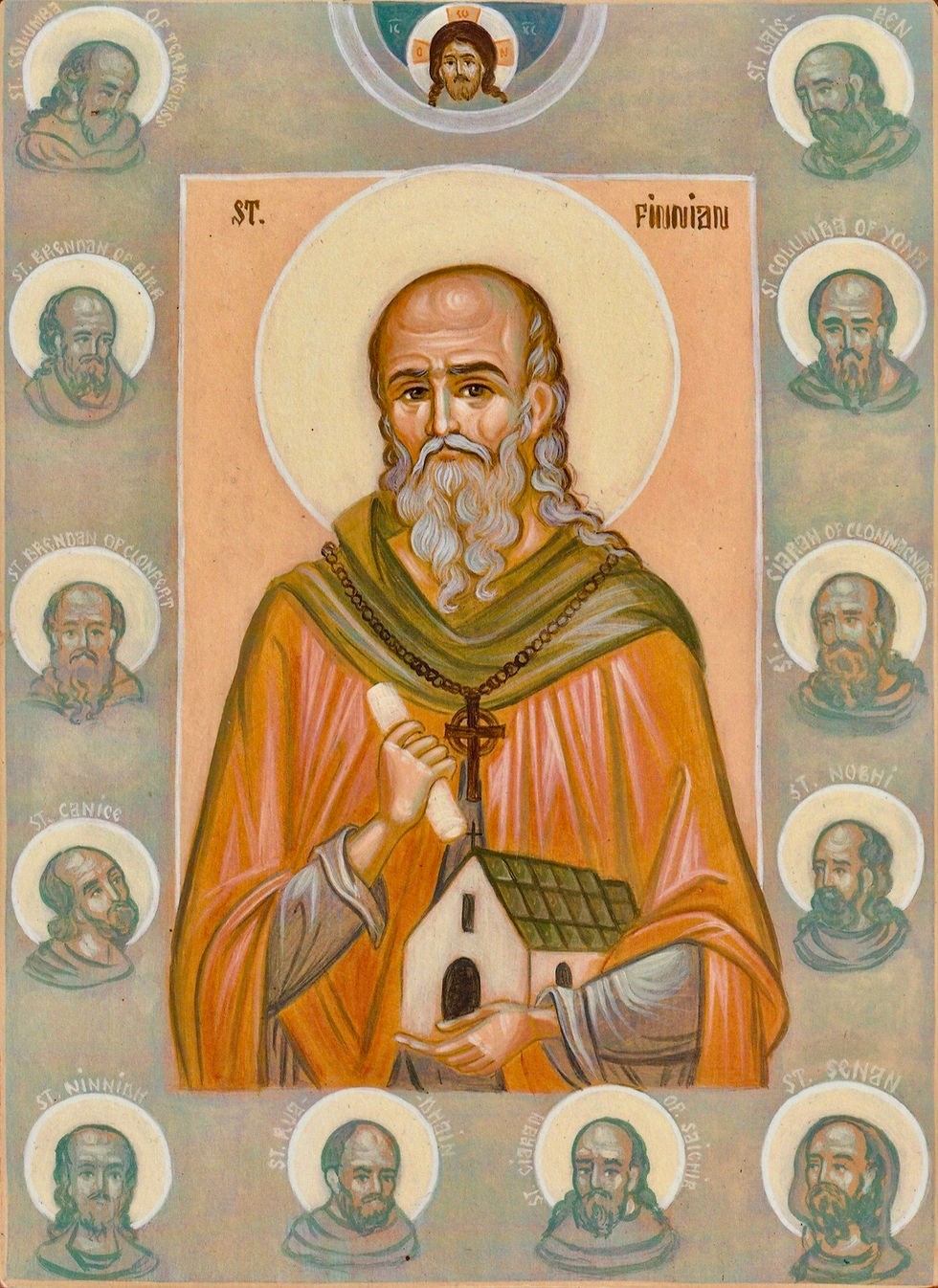
Born in Leinster, Ireland, St. Finnian was destined to become one of the most influential figures in Irish monasticism. His life story was compiled in the tenth century. The future saint is believed to have been born into a noble family in the latter part of the fifth century, most likely in the village of Myshall in what is now County Carlow.
"In one of her dreams while still pregnant, Finnian's mother envisioned a brilliant flame entering her mouth before transforming into a magnificent bird. This bird soared across the northern and southern regions of Ireland, attracting a large flock of other birds from all over the country to follow it. Upon sharing this vision with her husband, he recognized their child's destiny as an exceptional mentor and teacher. Ultimately, this prophecy came to fruition."
It is likely that the young St. Finnian received his education in Idrone, where St. Fortchern of Trim, a follower of St. Patrick, served as his first instructor. After some time, the saint established his initial three monasteries at Kilmaglush, Drumfea, and Rossacurra. Some sources suggest that St. Finnian briefly attended the renowned monastic center of St. Martin in Tours, Gaul. This ascetic undoubtedly studied the principles and techniques of monastic life in Wales, following in the footsteps of the great Egyptian hermits. Prominent Welsh Church fathers, such as St. David, St. Gildas the Wise, and particularly St. Cadoc, were among his instructors. This experience proved invaluable for the saint throughout his life.

After completing his studies in Wales, St. Finnian intended to travel to Rome.
"However, an angel appeared to him in a vision, instructing him to return to his homeland of Ireland to serve as "a teacher and tutor of Irish Saints."
Notably, one of the most influential early Irish missionaries, St. Columba, would become one of St. Finnian's future disciples. St. Finnian returned to Ireland after spending approximately 20 to 30 years in Wales, where he established numerous churches and monasteries, including those at Aghowle (in Wicklow) and Mugna Sulcain. Although he greatly enjoyed Aghowle and wished to remain there indefinitely, the angel reappeared to the holy man and urged him to continue on, as this was God's will.

St. Finnian became a travelling missionary, similar to other early Irish saints. He established monastic communities and built several churches on the island of Skellig Michael, near the coast of Kerry, which later became one of the most significant strongholds of Irish Orthodoxy. Subsequently, the ascetic spent a few years at the Kildare convent, run by the renowned Abbess St. Brigid. After leaving Kildare to continue his journey, he eventually arrived at Clonard, situated on the River Boyne in what is now County Meath. It was there that the Lord revealed the saint's primary mission would unfold in this ancient, pagan site, where no churches or monasteries had existed before his arrival.
Saint Finnian did not permit his multifarious labours in behalf of learning to interfere with his duties towards the needy and afflicted. We read in his life that he was a father to all who sought help.
"On a certain occasion a bard named German presented St. Finnian with a beautiful poem, in which many of his virtues were extolled; the bard demanded from the saint not gold or silver, or any worldly substance, but only fertility of produce in his lands. Finnian answered him, and said : "Sing over water the hymn which thou hast composed, and sprinkle the land with that water." The bard did as he was directed, and his land produced abundant fruit."
In the historical tale "The Expedition of the Sons of Carra," published by O' Curry in his MS. Materials of Ancient Irish History, we have a description of St. Finnian's interviews with three brothers, who had plundered the churches of Connaught. O 'Curry observes that while these tales often contain matter without resemblance to facts, we are not to reject them wholly on that account, but rather make allowance for poetic embellishment, at the same time having good ground for believing that a foundation of truth exists.
The story is as follows : -
" Three brothers actuated by an evil spirit plundered the churches of Connaught. In their wicked enterprise they were joined by a band of adventurers as daring as themselves. They commenced by pillaging the Church of Tuam, and never ceased till they had laid waste more than half the churches of the province. When the three brothers arrived at the Church of Clothar, they determined to kill the old man, who was the Airchennech of that place; he was their grandfather; but he, though suspecting their evil design, treated them with kindness, and assigned to them a comfortable resting-place. Lochan, the eldest of the three brothers, that night had a vision, which alarmed him so much that he became conscience-stricken. He saw represented before him the eternal joys of heaven and the torments of hell. When morning came he acquainted his brothers of what he saw, and like him they felt remorse for their wicked deeds. The brothers Carra sought the pardon and prayers of their grandfather. They took counsel with the old man as to what course they should pursue in order to obtain God's forgiveness and to make reparation for the past. He told them to repair to St. Finnian, the great teacher, and to submit themselves to his spiritual direction. The Ua Carra immediately put off their warlike attire, and donned the garb of pilgrims, and with staves instead of swords hastened to Clonard. At their approach the inhabitants fled, for the fame of their evil deeds had spread far and wide. St. Finnian alone came out to meet them; the brothers threw themselves on their knees, and besought his friendship and pardon.
'What do you want, said Finnian.' ' We want,' said they, ' to take upon us the habit of religion and penitence, and henceforward to serve God.' ' Your determination is a good one,' said Finnian, ' let us come into the town, where my people are.' They entered the town, and Finnian took counsel with his people respecting the penitents. It was decided that they should be placed for the space of a year under the direction of a certain divinity student, with whom alone they were to converse during that period. The Ua Carra faithfully complied with the mode of life laid out for them, and when the year expired presented themselves before St. Finnian for his benediction. The saint blessed them, saying, ' You cannot restore to life the innocent ecclesiastics whom you have slain, but you can go and repair, and restore as far as is in your power, the churches and other buildings which you have ruined.' The sons of Ua Carra took an affectionate leave of St. Finnian, and as the Church of Tuam was the first which suffered from their plundering, they wished it to be the first that they should restore. They repaired it, and proceeded from place to place, making amends for the injury they had inflicted on the churches of Connaught. Having restored all the churches but one, the Ua Carra returned to St. Finnian, who inquired if they had finished their work. They replied, 'We have repaired all the churches but one.' ' Which is that?' asked Finnian. 'The Church of Ceann Mara (Kinvara),' they said. ' Alas !' said the saint, ' this was the first church you ought to have repaired the church of the holy man Coman ; return now, and repair every damage, you have done to that place.' The brothers obeyed St. Finnian's command, and restored the church. By the advice of St. Coman they built a canoe, and undertook a voyage on the Atlantic Ocean."
Thus far the tale refers to St. Finnian ; the voyage and its results does not come within the scope of this paper.
St. Finnian's mode of life was very austere. He wore rough, raw-wool clothes and his usual food was bread and herbs ; on festival days he allowed himself a little beer or whey ; he slept on the bare grounds, and a stone served him for a pillow. Despite his severe asceticism, he was loved by the people for the gentleness of his heart and respected by the nobles for his wisdom, justice, and discernment.
In his last illness the saint was attended by his former pupil St. Colomb, of Tir-da-Ghlas, who administered to him the Holy Viaticum. The Four Masters record his death A.D. 548; but the year 550 or 551 appears to be the correct date. It is stated in some of our annals that Finnian died of the plague ; there is no doubt that the plague was in Ireland during this period, viz., 548 and 551. In the Chronicon Scotorum, under 551, we read : "A great mortality, i. e., the Chronn Conaill." St. Finnian is enumerated among its victims.
This great saint is commemorated by Oenghus in the following verse :
" A Tower of Gold over the sea,
May he bring help to my soul,
Is Finnian fair, the beloved root
Of the great Cluain-Eraird."
We must note that St. Finnian's sister, St. Regnach, was the Abbess of Kilreynagh, near the present town of Banagher, King's County.
Clonard Monastery
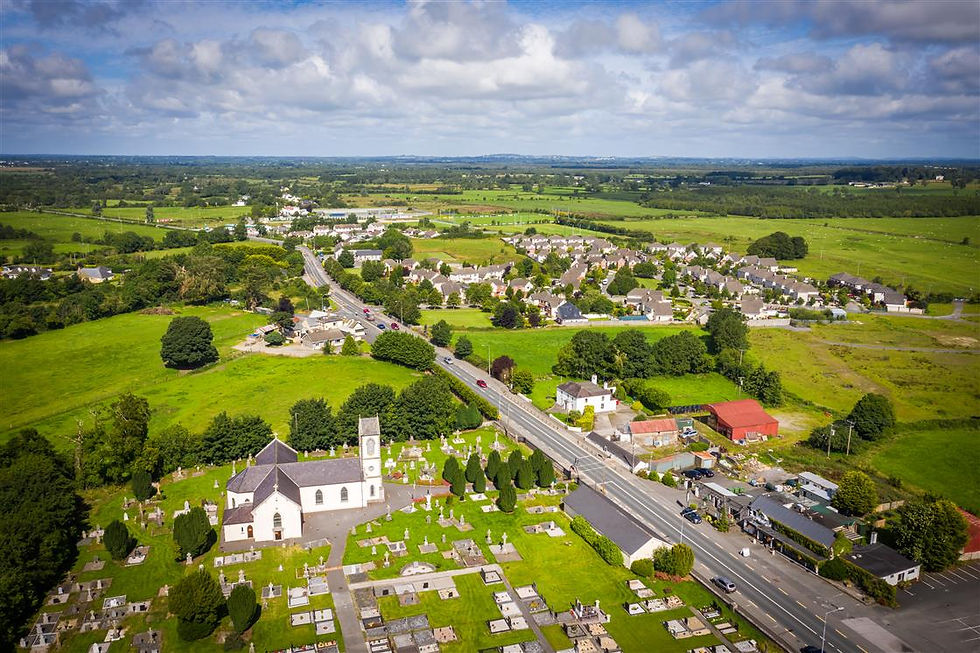
Initially, a small cell and church were built at Clonard, dedicated to St. Finnian. In 520, a monastery was established that grew to become the largest and most significant in Ireland. St. Finnian, using the customs of Welsh monasteries as a model, became the first abbot and established the monastic life there. This form of monasticism emphasized the study of the Holy Scriptures and was based on the practices of the Eastern holy fathers. Saint Finnian was the most highly revered saint of his time, attracting a large number of followers.
The “Twelve Apostles of Erin” were taught at Clonard including: St. Ciaran of Saighir; St. Ciaran of Clonmacnoise; St. Brendan of Birr; St. Brendan of Clonfert; St. Colum of Terryglass; St. Columba of Iona; St. Mobhi of Glasnevin; St. Ruadhan of Lorrha; St. Senan of Iniscathay; St. Ninidh of Loch Erne; St. Lasserian Mac Madfraech; St. Canice of Aghaboe. His faith inspired a whole generation.
According to historical accounts, over 3,000 monks lived in Clonard during that period. He was sought after for spiritual guidance by laypeople, monks, bishops, priests, wealthy individuals, and the impoverished alike. St. Finnian was loved and revered for his exemplary life, wisdom, gift of prayer, and numerous miracles, which contributed to his popularity extending throughout Ireland and beyond. His monastery welcomed monks and theologians from many nations, where thousands studied the Bible and the writings of the Church Fathers, developed their monastic practices, and were eventually sent as missionaries to distant lands. Clonard was renowned for its discipline and ascetic labors. The brethren worked diligently, ate sparingly, prayed earnestly, slept little, and rose early. In his austere cell, St. Finnian slept on the bare clay floor without placing anything beneath his head. His iron girdle served as a form of penance during his ascetic labors. One of his disciples noted that the years of rigorous austerity made the venerable abbot so thin that his ribs were visible through his clothing.

The monastery thrived until the ninth century and was considered the second-most prominent monastery in Ireland, following Armagh. However, its glory faded after Viking attacks from the ninth to the eleventh centuries. Visitors today can see a statue of St. Finnian at Clonard, along with a church dedicated to him that features stained glass depictions of the saint with his followers. Only small remnants of the old monastery remain.
Hundreds of churches and monasteries were established by the followers of Clonard in Ireland and other countries. Each monk who left the monastery to serve as a missionary took with him a copy of the Gospels, a crozier, and a holy item, such as a reliquary. When he built his own church or monastery, he would deposit these relics inside. As a result of Clonard and other renowned monasteries, Ireland earned the title of "The Island of Saints." St. Finnian established the first Irish Penitentiary, guided by Welsh saints and initially influenced by St. John Cassian in Gaul. This endeavor inspired St. Columba to create his own, more widely recognized version. The Abbot was also noted for his skill in interpreting the Bible.
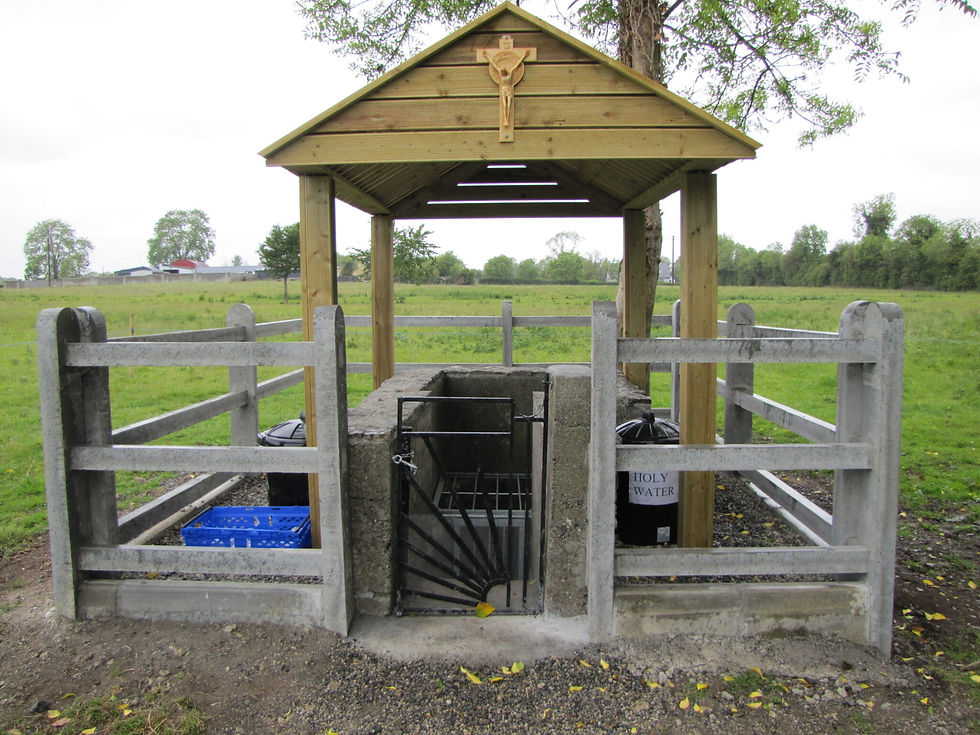
One of St. Finnian’s main considerations when selecting the site for his monastery at Clonard was access to a clean water supply. Wells provided clean water and could be used as a source of holy water and even utilized for baptising new converts. An angel warned Finian to move the well from the spot he had selected and leave that ground as the cemetery and that is what Finian did. Leaving Ard na Reilig, the height of the cemetery, Finian founded his monastery nearby and dug a new well. St. Finian moved his monastery to the hill called Church Hill and the well on the eastern side is now the holy well.
Cures were attributed to the waters of St. Finnian’s Well. St. Finnian is said to have bestowed a blessing on the people of Clonard whereby nobody from the area would ever be killed by lightning.
In the 1930s the well was described as about three feet in diameter and about three feet wide and was neglected. No pattern was held there at the time. In recent years a wall was erected around the well and steps allowing access to the water were constructed. The well features on the Clonard Heritage Trail. For the Clonard pilgrimage in 2011 a new entrance was created to the well to facilitate pilgrims.
His repose
Around the year 549, Ireland was struck by a devastating epidemic. Wishing to serve the suffering, Saint Finian fearlessly went among the sick, caring for them with his own hands and strengthening them through prayer. He himself contracted the disease. The saint was attended by his former pupil St. Colomb, of Tir-da-Ghlas, who administered to him the Holy Viaticum, and after a short time, he fell asleep in the Lord. His memory remains alive as the father of Irish monasticism, a great teacher of holiness, and a model of a pure, humble, and sacrificial life. His remains were kept in the Clonard convent church until 887. Evidence suggests that some of his relics were housed in a parish church near Clonard until the 17th century when barbarians vandalized his primary relics.
In the Carlow village of Myshall, where St. Finnian is believed to have been born, are the ruins of a pre-Norman church that existed for many years before Cromwell destroyed it in the 17th century. St. Finnian himself built the old monastic church in the village of Aghowle in the early sixth century, and its remnants can still be found there. Nearby, a new St. Michael's Church was constructed in the eighteenth century. An old St. Finnian cross also remains in this village. Additionally, a Russian Orthodox mission honoring St. Finnian exists in Belfast, Northern Ireland.
His Feast day is the 12th of December NC / 25th of December OC

Troparion of St Finnian of Clonard tone 8
Truly thou art the 'Tutor of the Saints of Ireland', O Founder of Clonard, great Father Finnian.
As thou didst tirelessly teach the faith in thy native land,
so teach us to follow thy example that many may come to know Christ and be led into the Way of Salvation.
Sources: oodegr.com, meath.ie, celticsaints.org, orthochristian.com


Comments