
Saint Ciaran of Clonmacnoise
Updated: Nov 5

St. Ciaran (Kieran) of Clonmacnoise, also known as "Ciaran the Younger," was born around 512 (or 516) to the family of an itinerant carpenter and chariot-maker in the western Irish province of Connacht, which once was a kingdom.
Early Life
His birthplace is now located in County Roscommon, specifically in Fuerty. His parents, Beoit and Darerca, had several children, some of whom, like Ciaran, dedicated their lives to God's service. Ciaran inherited his family's strong love of wisdom and learning. Justus, a holy priest, baptized him and served as his first spiritual instructor.
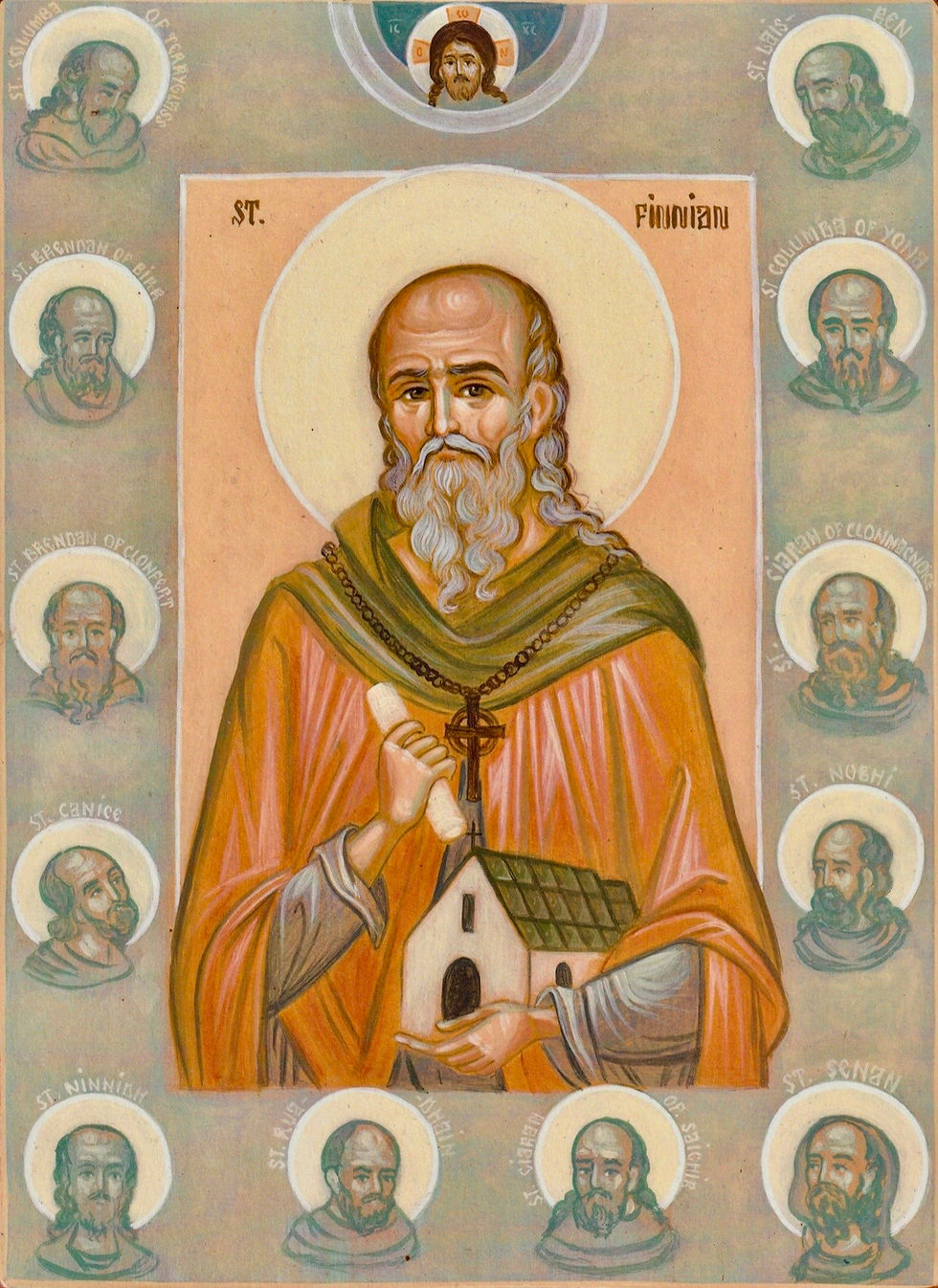
During his childhood, Ciaran worked as a cowherd to help support his family. His early life is marked by signs of holiness, which are credited as his first miracles. Ciaran was educated by the renowned theologian St. Finnian of Clonard, who was the spiritual father of the "Twelve Apostles of Ireland."
He proved to be an exceptionally bright student and one of the most dedicated monks. The Lord performed additional miracles through him.
"There is a story that one day the students were studying the Gospel of Saint Matthew when Saint Ninnidh came into class without a book. He asked Ciaran to lend him his, which he did. So when Finnian tested the class, Ciaran knew only the first half of the Gospel. The other students laughed and called him “Ciaran half-Matthew.” Saint Finnian silenced them and said, “Not Ciaran half-Matthew, but Ciaran half-Ireland, for he will have half the country and the rest of us will have the other half.”
After spending some time at Clonard, he continued his studies with another notable saint of the era, St. Enda of Inishmore, on one of the Aran Islands in western Ireland. Ciaran would spend seven years at this island monastery, ultimately being ordained as a priest.
"According to legend, he once had a vision of a magnificent miraculous tree, which appeared to grow extraordinarily tall from the center of Ireland. This tree was said to protect the entire "Emerald Isle" (i.e., Ireland), its delicious fruits surrounding the country, while beautiful birds transported some of the fruit to other territories. St. Enda recognized that the miraculous tree symbolized Ciaran himself, who was esteemed in the eyes of both God and man, destined to nurture and protect all of Ireland with his grace and become a true mentor to many."
“Your life will bring honour to Ireland, and the protective influence of your faithfulness and grace will guard her from evil, disease, and danger. The fruit of your life will benefit many people, both near and far. Therefore, by God’s command, go without delay to the place where you are to die and rise again—a place that God will show you—so that your life may be a blessing to many.”
These words are a prophecy spoken to Ciaran by Abbot Enda of Aran.
Mission
Consequently, St. Enda advised St. Ciaran to establish a monastery in central Ireland.
Later, he went to visit his brothers Luachaill and Odhran, who had a foundation at a place called Isel. Ciaran’s charity was so great that his brothers asked him to leave. They said, “Brother, leave us for we cannot live in the same place with you and feed and keep our brethren for God, because of your unbounded lavishness.”
Saint Ciaran left them and set off with his books in a bag. On the way he met a stag and placed the bag on its back. He followed the animal until he came to Lough Ree opposite Hare Island, where he founded a monastery. Leaving his brother Donnan (January 7) as abbot, he went to dwell in the wilderness.
St Ciaran then migrated to Lough Ree (with "Lough" being the Irish term for lake) and established himself on an island. For another seven years, he lived as an ascetic and founded his own monastery. It is believed that during this time, he also lived on Scattery Island,

where he was spiritually mentored by St. Senan, a prominent contemporary Irish monastic founder. The saint may have briefly visited other Irish islands, such as Hare Island, where he founded small communities and performed miracles.
Ciaran's labors during this period prepared him for the most significant assignment of his life. Ciaran eventually constructed his major and largest monastery at Clonmacnoise on the west bank of the River Shannon in what is now County Offaly, Ireland, around the year 544 (or 548). He foretold that many souls would ascend to heaven from this location, that the Lord would be especially present here forever, and that many faithful Christians would continually visit. According to legend, the saint was instructed to establish this monastic complex at a different, more attractive site, but he refused, arguing that the beauty of our fleeting life should not distract monks from their desire for heavenly and spiritual heights.

"Ciaran became the first Abbot of Clonmacnoise and established an ascetic rule for his brethren, known as "The Rule of St. Ciaran." Soon after, more than half of all Irish monasteries adopted this stringent ascetic rule."
Above all, the saint supported his preaching with his example, as he was regarded as a man of faith, prayer, fasting, work, humility, learning, and discipline, as well as a protector of the poor. Diarmait, the future high king of Ireland, was said to have assisted Ciaran in establishing the monastery and vowed to endow it with lands to meet its needs.
Ciaran, a remarkable ascetic and wonderworker, is one of the "Twelve Apostles of Ireland." Like many other saints, particularly those from the Celtic Christian tradition, he lived in complete harmony with nature. His Life recounts the story of a dun cow that lived alongside the saint throughout its life and provided milk for the monastery. According to mythology, in the early twelfth century, the skin of this cow was used to create one of the most extraordinary manuscripts in Irish history, known as the Book of the Dun Cow.

This manuscript is a compilation of religious, historical, political, and literary texts. Today, this remarkable folio, many pages of which are unfortunately damaged, is housed in the Royal Irish Academy.
"Another legend states that when St. Ciaran was a student, a tame fox delivered his completed written assignments to his teacher. During a famine, Ciaran prayed fervently to God, asking that the small amount of oats he was bringing to the monastery's mill be transformed into excellent wheat. While he was still praying, a single sack of oats miraculously changed into four large sacks of high-quality wheat! When the brethren baked bread from this wheat, they discovered it was the best bread they had ever tasted, and it even healed some of them from illness."
His Repose
Ciaran was reported to be so modest and meek that just before his death, he urged his pupils not to bury his body in the ground but rather to leave it on a hilltop, like the bones of a deer.
"St. Ciaran died of the plague around 545 (or possibly 549), at the age of 33. Several other Irish saints succumbed to the same disease during that period. Although his abbacy lasted less than a year, Ciaran became a saint and served as a father figure to thousands of Irish monks for generations."
St. Columba of Iona, a friend of St. Ciaran who had studied with him at Clonard, described him as "a lamp shining with the light of true wisdom." Ciaran's acquaintances included St. Kevin, the legendary hermit and wonderworker of Glendalough. Alcuin (c. 735-804), an English scholar at the Frankish court who had studied at Clonmacnoise, referred to St. Ciaran as "the glory of the Scots" (meaning the Irish).
His Legacy
Many notable chroniclers, poets, theologians, artists, architects, sculptors, and historians were educated at this renowned monastery, including Dicuil, a talented geographer. St. Ciaran founded the monastery of Clonmacnoise with only ten disciples initially, but it grew rapidly. By the eighth and ninth centuries, it had become the largest Irish monastery and a center of study and culture. Its school-seminary, built by the abbot himself, earned the reputation of being "a smithy of saints." Researchers emphasize that the seminary had a national, as well as regional, scope.

"In the eleventh century, the original small wooden monastery was replaced by an expansive new stone monastery that housed between 1,500 and 2,000 monks. Between the seventh and twelfth centuries, when the monastery was at its peak of splendor, hundreds of scholarly monks from all over Europe flocked to Clonmacnoise."
Clonmacnoise developed into a prominent monastic city and was considered the most famous in Ireland. The monastery included a school, a scriptorium for transcribing manuscripts, and numerous churches. The masters of Clonmacnoise produced some of Ireland's finest stone and metal artworks. It served as the burial site for many rulers from Connacht and Tara. By 1408, the monks had completed The Annals of Clonmacnoise, a chronicle detailing historical events in Ireland from prehistory to that year. The monastery featured a significant number of high and round Celtic crosses; however, most were destroyed by Vikings and, in 1552, by fanatical Protestant iconoclasts who attacked and desecrated Clonmacnoise Cathedral.

This revered monastery thrived until the sixteenth century, enduring forty raids in total. The shrine containing the saint's remains was desecrated and looted multiple times.
Nevertheless, St. Ciaran's staff survived and is now housed at the National Museum of Dublin.
Catholic and Orthodox pilgrims visit Clonmacnoise today to admire the well-preserved ruins of the ancient monastery. Several ancient churches still stand on this mediaeval monastery site (the nearest town, Athlone, is about twelve miles away), and several have recently been restored. St. Ciaran's Church, built in the ninth century, is the burial place of St. Ciaran.

Clonmacnoise also features a Cathedral, originally erected in 909, which has recently undergone partial renovation. Remarkably, several rare Celtic crosses of exceptional interest have survived to this day. Notably, one primary school in Dublin is named after St. Ciaran.
It is important to distinguish St. Ciaran of Clonmacnoise, one of the most prominent figures in Irish monasticism, from another illustrious saint sharing the same name—St. Ciaran (Kieran) "the Elder", Bishop of Ossory and Abbot of Saighir, who lived in the late fifth to early sixth centuries.
St Ciaran's holy well

This holy well may be some 800 metres south of the monastic city, but was a very important part of the pilgrimage route at Clonmacnoise. It was the first stop for the pilgrims who decided to do the "Long Station". They would customarily walk in bare feet, circumnavigating the well. Then stop to pray at the slab bearing a crucifixion and kiss the head of Christ. They would pray at one of the two stone heads that existed here; only one remains today. There is also a cross inscribed slab at the holy well, pictured below, typically carved in the style associated with Clonmacnoise.

The pilgrims would more than likely leave a votive offering at the well before walking north to the monastic city. There they would continue their journey by doing three circuits of the graveyard stopping at the various churches and crosses to pray. They would then travel along the pilgrims way to the Nuns' Church which is a further 500 metres north of the main complex, stopping to pray at the cairn of the three crosses on the route. The final stop was at St Fingins well. The pilgrimage takes place on the 3rd Sunday of September. A local man had stopped to pray at the well at the time of our visit, proving the tradition of visiting holy wells is still very much alive in Ireland today. The practice of visiting holy wells was made even more popular during penal times.

COMMEMORATION 9th SEPTEMBER
Troparion — Tone 8
By a flood of tears you made the desert fertile, / and your longing for God brought forth fruits in abundance. / By the radiance of miracles you illumined the whole universe! / O our holy father Ciaran, pray to Christ our God to save our souls!
Holy Father Ciaran of Clonmacnoise, pray to God for us!
Sources: orthochristian.com , oca.org , megalithicireland.com


Comments