
St Helen of the Cross, the Queen Empress of Rome
Updated: 4 hours ago

St. Helen, also known as St. Helena or Helen of the Cross, the first Christian Empress, holds a revered place in the history of Christianity. As the mother of Emperor Constantine the Great, her life was instrumental in the transformation of the Roman Empire from a pagan society to one where Christianity flourished. Her unwavering faith, humility, and dedication to the discovery of sacred Christian relics inspire countless faithful to this day.
"There are conflicting opinions about her birthplace. Born around 246–248 British claim that Helen was high born in Britain, contrary to the belief in the East that Helen was born in Drepanon (later renamed Helenopolis) in Bithynia, in Asia Minor, she came from humble origins, and that she was an innkeeper’s daughter from the Balkans (Illyria)."
Referring to the online version of the Catholic Encyclopedia, we read under ‘St. Helena’: ‘She was of humble parentage; St. Ambrose, in his "Oratio de obitu Theodosii", referred to her as a stabularia, or inn-keeper.’ St Ambrose was the Bishop of Milan from AD 374-397. His suggestion, provided without evidence, that in the previous century a future Roman Emperor had in early life married, though temporarily (she was divorced later on), into the pub trade seems highly unlike. We certainly cannot call evidence a note in the margin of an old manuscript.
It was the pious boast of the city of Colchester, England, for many ages, that Saint Helen was born within its walls; and though this honor has been disputed, since others say she was born in York, it is certain that she was a British princess.
Helen believed that was the daughter of King Coel II, who died in the early AD 300s. Coel II is not to be confused with Coel I, who apart from reigning himself in the AD 100s was the father of King Lleirwg, known to the Romans as Lucius or Luke, the first Christian king anywhere. There is also Coel III, who reigned in the AD 400s.
To learn more of Coel II, his daughter Helen and their times, reference can be made to the Tysilio Chronicle of the seventh-century British monk Tysilio, using the 2002 translation of Wm R Cooper. We read of the time of Diocletian, Emperor of Rome AD 284-305, during which Asclepiodotus, Earl of Cornwall, came to power in Britain and St Alban was martyred.

"‘And after these things, Asclepiodotus took the crown and ruled the kingdom for twenty years. And in his days began the persecution which Diocletian, emperor of Rome, instigated against the Christians, almost wiping out the Christian faith…And then arose Coel, earl of Gloucester, and he fought against Asclepiodotus and straightway slew him. And then Constans (Constantius Chlorus), a senator of Rome who had been subduing Spain, came [with his host] to Britain to make war against Coel. But, having named the day upon which battle was to be given, they suddenly made peace. And when but a month and a week had passed by, Coel died. And he had held the crown for ten years. And Constans (Constantius Chlorus) took Helen as his wife, [she being] the only daughter of Coel. And she was surnamed Helen the Fair, for such beauty of face and figure had never before been seen. And a son was born to them whose name was Constantine, the son of Constans (Constantius Chlorus). And this is he who wrested Rome from [the hands of] Maxen the Cruel, he and his three uncles, his mother’s brothers, who were called Ioelinus, Trahern and Marius."
As we will learn, this notice sets the marriage of Helen too late for her to produce a son, Constantine, old enough to take over the empire when his father dies. We will tackle and overcome this vital chronological challenge later, by showing that although the key elements are all present in Tysilio, the account is garbled.
For now we will refer to Geoffrey of Monmouth’s History of the Kings of Britain of
1136. This was described by the archaeologist and historian Flinders Petrie as a ‘flowery expansion’ of Tysilio [see More 4], yet Geoffrey may sometimes be consulted with profit for additional information, from whatever conjectural source he acquired it. Geoffrey describes Helen’s husband ‘Constans’ in Tysilio more correctly as Constantius, while agreeing that he succeeded Coel. In contrast to Tysilio though, Geoffrey tells us that Helen was brought up as a queen-in-waiting because of a lack of brothers.
Tysilio informs us that Ioelinus – said to be Helen’s brother, but an uncle in Geoffrey – married the daughter of a Roman senator. Their son Maximianus, we learn, went on himself to rule Britain, crossing from there into Gaul and killing Gratian, co-emperor of Rome. The modern translator of Tysilio tells us in a footnote that this occurred in Lyons in AD 383. Tysilio later has the great King Arthur himself recalling to his knights “…Constantine, the son of Helen and the great Maximianus, nobles all of the land of Britain…”.

In E O Gordon’s Prehistoric London, first published in 1914, there is a page entitled ‘St Helen of Britain at Trèves’. Trèves is the French name for Trier, a German city on the banks of the Moselle River, which had been the capital of Belgic Gaul. In De Imperatoribus Romanis, an online encyclopedia of Roman Emperors, under ‘Helena Augusta’, we learn that Constantine’s foremost residences in the West were Trier and Rome and that Helen may well have lived at Trier.
Here is what E O Gordon has to say on Helen at Trèves:
‘Trèves is more closely connected with our early British monarchs than any other continental town, from its having been the favourite residence of the QueenEmpress Helena, who founded here the first Christian Church in Germany. The basilica of the palace of her husband, Constantine Chlorus, forms the actual walls of the present Cathedral. From her gifts of one of the nails of the Cross, of the Holy Coat, and other relics, the name of King Coel's beautiful and accomplished daughter "Elaine" is held in the greatest veneration as a patroness of the city. And it is of no little interest to find that the ruins of the imperial palace at Trèves, built by her son Constantine, bear so strong a resemblance to similar ruins in Colchester that postcards of the one may easily be taken for those of the other.’

Princess Helen was the first wife of Constantius Chlorus (‘the Pale’), a Roman
Emperor who in fact died in the north of Britain in AD 306. Helen, born around AD
248, was a British Christian and so, momentously, was her only son Constantine the Great, a pivotal figure in world history. So scurrilous has been the treatment of Helen that in some accounts – though not that of the Catholic Encyclopedia – she has even been denied the status of a wife and been described as a concubine, which would make Constantine illegitimate. This is patently absurd as Constantius Chlorus is attested as having later divorced Helen for political reasons, as we shall see. You cannot divorce someone to whom you are not married!
"According to De Imperatoribus Romanis, cited previously, Philostorgius (Hist. Eccl., 2.16) called Helen ‘a common woman not different from strumpets’. This is a woman whose image was to appear on coins, whose inscription indicated her rank as Nobilissma Femina, and who, after 324, was to receive the title of Augusta.
To appreciate the true provenance and status of Helen, it will be helpful to establish the correct chronology of events. To this end, reference can be made to The British Chronicles (Heritage Books, 2008) by present-day author David Hughes, who has evidently steeped himself in the ancient sources. On page 115 of the first of Hughes’s monumental two volumes there is much of interest. In this passage, Coel is referred to as ‘Coilus [II]’ and ‘wledic’ is defined later as representing a national office, ‘Prince of Britain’;."
‘The Roman Emperor Aurelian[us] was called “restitutor orbis” [“restorer of the world”] for re-uniting the Roman Emperor, ending the “Age of Pretenders”.... Roman authority was restored in Britain in 274 by Constantius “Chlorus”, one of Aurelian’s generals, whom the Roman emperor sent to Britain with the mission to bring the lost province back into union with the empire. Coilus [II], the British “wledic”, surrendered immediately to Constantius “Chlorus” on his landing with a Roman Army in Britain. Thus, the last break-away province, Britain, was re-incorporated into the Roman empire. It was at this time that Constantius “Chlorus” married the British princess St. Helena, the daughter of the British “wledic” Coilus [the later king], and begot a son, Constantine, i.e. Constantine “The Great”. Legend says that Constantine “The Great” was born in Britain in 275 either at York or Caernarvon Castle, however there are other legends that put his birth-place at other sites. Constantius “Chlorus” was recalled during the unrest following the murder of the Roman Emperor Aurelian[us] in 275.’
After this visit to Britain in 274, Constantius Chlorus returns twice more to Britain, in 296 and 305. According to Hughes, the situation in 296 was as follows:
‘ASCLA (ASCLEPIODOTUS) (ALYSSGLAPITWLWS), the Duke of Cornwall, was elected King of Britain by the city-dukes in a convention in London, occupied by the Roman Army under Constantius “Chlorus”. It was Constantius’ second tour-of-duty in Britain. Constantius assents to the election of Ascla as king, or client-king, for
Ascla has earlier been his “praetorian prefect” as was his duty in Roman service…’
Hughes’s list of rulers of Britain in the relevant period goes like thus:
296-305 | Ascla (Asclepiodotus) |
305 | Coilus II |
305-328 | Helena “The Saint” |
305-306 | Constantius “Chlorus” |
306-337 | Constantine I “The Great” |
Abbreviating Geoffrey of Monmouth as ‘GM’, Hughes gives this report of the year 305, which was to see the third of Constantius’s visits to Britain:
‘…Ascla was killed by the British city-duke Coilus, identified with GM’s Duke Cole of Colchester, who held national-office as the British “wledic” [“Prince of Britain”], and usurped the nation’s throne as King Coilus II.’ Coel (Coilus II) then surrenders the crown to Constantius Chlorus, dying shortly afterwards, as reported in Tysilio.
Hughes’s entry for Constantius Chlorus reads thus:
'305-306 CONSTANTIUS “CHLORUS”, on King Coilus’ death, seized the British Crown in trust for his ex-wife, St. Helena, and their son, Constantine, and reigned as King of Britain for about a year. Constantius about that time also became Roman Emperor on the abdication of Maximian and transferred the imperial court [again] to York. He was joined in Britain by his father, Eutropius, the ex-governor of Illyria [Yugoslavia] in Roman service, and by his son, Constantine.’
We then read the following, at the end of the same entry, after some material on Ireland:
‘The Picts renewed their raids on Roman Britain during the reign of Constantius, and he defeated them in battle in 306 and slew their king, Fyandor “Albus”. This was his second northern [Scottish] expedition against the Picts; his first had been during his second tour-of-duty in Britain in 296. It was shortly after the northern campaign that Constantius died, in 306 (23/25 July), and was succeeded as King of Britain by his son Constantine…’
The ninth-century monk Nennius in his Historia Brittonum lists seven Roman emperors who held power in Britain. The fifth is tantalisingly called ‘Constantine, son of Constantine the Great’. As this emperor is described as dying in Britain, presumably the entry should have read ‘Constantius, father of Constantine the Great’. Yet maybe there is a confused echo here of both men.
"Hughes’s next entry reads as follows:

‘306-337 CONSTANTINE I “THE GREAT”, reigned as King of Britain for thirty years, however, was an absentee monarch for most of that time.’
Hughes’s notice for Helen precedes those of Constantius Chlorus and Constantine.
‘305-328 HELENA “THE SAINT”, queen/empress, was associated in the reigns of her husband and son… in 306 upon her husband’s death, her son, Constantine, succeeded his father in Britain as “King of Britain”, and mother and son reigned coequally over Britain.’
This discloses why Helen has always been described as a Queen Empress. The title is incomprehensible in the context of a low-born origin."
We believe that with these notices David Hughes has established the correct chronology, reign lengths and events. Constantius Chlorus made three visits to Britain, in 274, 296 and 305. On the first of these visits the gallant Constantius was awarded in marriage the beguiling Helen and shortly afterwards, in 275 in fact, she bore him Constantine, who was thus high born within wedlock.
In her eightieth year she made a famous pilgrimage to Jerusalem, with the ardent desire of discovering the cross on which our Blessed Redeemer had suffered.
Tragedy in the Imperial House
Her son's Emperor St Constantine’s role in church history was three-fold: historical, political, and spiritual. All speculative criticism of his personal faith and relationship with the Church are reduced to ‘slander and propaganda’ once the observer has submitted to the accurate historical, political and spiritual context of Constantine’s life.

Even the ‘executions’ of his son and wife have an authentic context.
Critiques of Constantine’s character often cite these deaths as proof of his utter depravity. However, recent scholarship, such Alessio Torino’s The Crispus Tragedy, has returned decisively to the opinion that the degree of intrigue culminating in the deaths of Crispus and Fausta was of such offense that an obscuring effort is to be expected. In hindsight, Zosimus himself, an outright enemy of Constantine’s faith, and the Byzantine historian Ioannes Zonaras, provide the most compelling account.

"Fausta, wife and daughter of Constantine’s enemies, apparently viewed her stepson Crispus with extreme jealousy since he competed with her sons for imperial favor. Conspiring against Crispus only a month after Constantine had decreed adultery punishable by death, Fausta feigned impassioned love for her stepson and the idea of an illicit relationship. Crispus, like Joseph tempted by the Egyptian woman, denied her. Fausta retaliated by reporting to Constantine that Crispus had disgraced him in an attempt to rape her. Trusting the false testimony of Fausta, and being personally shamed so soon after his decree against such things, Constantine gave his beloved son over to trial and execution."
When Saint Helena, the Emperor’s mother—who was away at the time—learned of the event, she sternly rebuked her son, the Emperor, for his decision. Constantine immediately ordered a thorough investigation, which revealed that he had fallen victim to a criminal conspiracy orchestrated by his wife, Fausta, and her inner circle. He then ordered her execution as well. These two killings within his own family deeply shook Constantine; for the rest of his life, he would sigh and lament over these events, praying for God’s forgiveness. Furthermore, in order to publicly demonstrate his repentance, he erected a statue of Crispus bearing the inscription: "To my wronged son."
The Search for the Holy Cross

The empress Helen journeyed to Jerusalem with a large quantity of gold. Saint Constantine wrote a letter to Patriarch Macarius I (313-323), requesting him to assist her in every possible way with her task of the restoring the Christian holy places.
After her arrival in Jerusalem, the holy empress Helen began to destroy all the pagan temples and reconsecrate the places which had been defiled by the pagans.
In her quest for the Life-Creating Cross, she questioned several Christians and Jews, but for a long time her search remained unsuccessful. Finally, an elderly Hebrew named Jude told her that the Cross was buried beneath the temple of Venus. According to another Legend, the sweet fragrance of basil led Saint Helen to the Cross of Christ. In Greek, basil is derived from the word for “king.” After praying for help, she found the plant growing over the location of the true Cross.
Saint Helen ordered that the pagan temple be demolished, and for the site to be excavated. Soon they found Golgotha and the Lord’s Sepulchre. Not far from the spot were three crosses, a board with the inscription written by Pilate (John 19:19), and four nails which had pierced the Lord’s Body.

Now the task was to determine on which of the three crosses the Savior had been crucified. Patriarch Macarius saw a dead person being carried to his grave, then he ordered that the dead man be placed upon each cross in turn.

When the corpse was placed on the Cross of Christ, he was immediately restored to life. After seeing the raising of the dead man, everyone was convinced that the Life-Creating Cross had been found. With great joy the empress Helen and Patriarch Macarius lifted the Life-Creating Cross and displayed it to all the people standing about.
The miraculous discovery and verification of the true Cross is still celebrated by the Church on the 3rd of May. The pious empress, transported with joy, built a beautiful Basilica on Mount Calvary to receive the precious relic, sending portions of it also to Rome and Constantinople, where they were solemnly exposed to the adoration of the faithful.
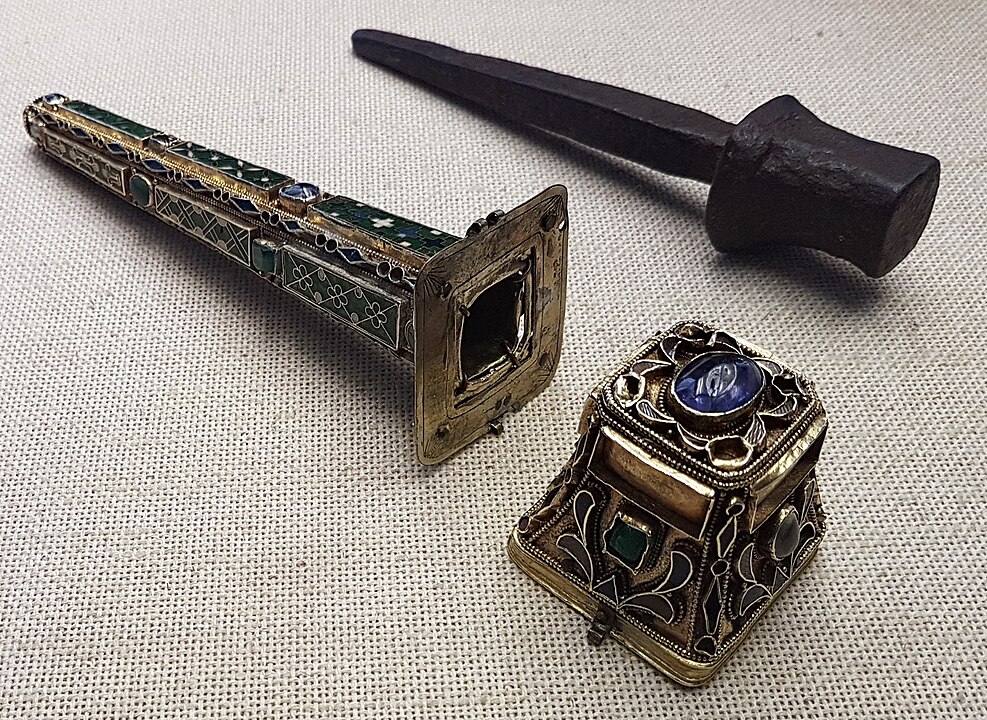
"In the Orthodox tradition, it is believed that while fragments of the Holy Cross were cut and sent as blessings, the Holy Cross would miraculously renew itself. It remains uncertain when this miracle ceased."

She built two other famous churches in Palestine to honor the sacred sites of Our Lord's life, one at the site of His Ascension, and the other, known as the Basilica of the Nativity, in Bethlehem, which she and her son richly adorned.
Many sacred relics were found through her diligence, including the Seamless Robe of Jesus Christ.
She returned to Constantinople with a portion of the Life-Giving Cross, the Seamless Robe and the Nails with which the Lord’s Body had been affixed. One of these Nails and the Robe are kept today in the Cathedral of St. Peter in Trier.
The cathedral was commissioned by Emperor Constantine the Great and built on top of a palace of Saint Helena, his mother.
Following the conversion of Constantine to Christianity, Bishop Maximin (329–346) is said to have coordinated the construction of a cathedral, which at the time was the grandest ensemble of ecclesiastical structures in the West outside Rome.
Repose

When past the age of 80, Saint Helen, reposed in Rome with her son Constantine nearby in around 328 –330 AD, not long after returning from her pilgrimage to the Holy Land.

Constantine had her buried in the Mausoleum of Helena on the Via Labicana outside Rome.
Her large porphyry sarcophagus was later moved to the Lateran and is now held in the Vatican Museums.

Her remains are currently at the church of Sant'Elena, Venice at the eastern end of the Castello district in Venice, Italy. According to tradition, a monk named Aicardo brought Helena's remains from Constantinople to Venice in 1211 following the Fourth Crusade.
The Orthodox Church commemorates Equal-to-the-Apostles Saint Helen and her son, Saint Constantine, on May 21/June 3
Troparion — Tone 1

The Empress Helen, mother of Constantine the Great, was with us before she sought the Cross in Jerusalem. Thus, becoming like unto the apostles, She calls us also to honour the Cross, for in this sign, the standard of victory over the enemy, we are granted salvation and resurrection, and the triumph of the Heavenly Jerusalem. Wherefore, O holy Helen, pray to Christ our God that our souls may be saved.
Kontakion — Tone 3
The power of the Most-high truly descended upon you from on high, O blessed Helen, as you venerated the Holy Lands in reverence, and because of this, you raised up a divine temple that was greatly beautified, crying out to Christ the Savior: Alleluia.
Sources: thenationalcv.org.uk , sanctoral.com , ourladyandsthelen.org , orthodoxpatrick.ie


Comments